
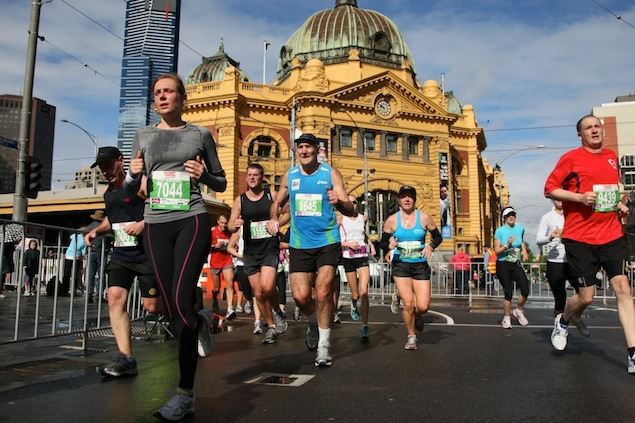
With 5 event distances to entice everyone off the couch, the Nike Melbourne Marathon Festival is back big time. Runners (and walkers) can choose from five distances from a full marathon (42.195km), half marathon (21.1km), wheelchair full marathon (42.195km), a 10 and 5 km run, a 2.k walk, and a mini marathon for the kids (1km). All events are starting on Batman Ave, Melbourne and finishing with a lap of honour around the hallowed turf at the MCG.
The Nike Melbourne Marathon Festival takes pride in their commitment to the environment, and the 2025 event hosts a myriad of ways in which they demonstrate that, including …
- water stations along the path to cut down on plastics,
- limiting promo material,
- use of compostable cups and other eco products,
- the lead car is electric,
- use of solar powered venue (MCG),
- strategic waste streams implemented,
- 100% recyclable participant’s bibs,
- unclaimed clothes are taken to Upparel for recycling,
- and their biggest sustainable commitment is to their carbon offset and self-sustaining biodiverse ecosystem program. They are achieving this by partnering with us to plant 5,000 native plants in Melbourne and rural Victoria.

The Nike Melbourne Marathon Festival in conjunction with our participants are committed to the continual improvement in the sustainable practices of this iconic race. As part of our four-stage strategy to eliminate, reduce or reuse, mitigate and offset, the Melbourne Marathon Festival is pleased to be partnering with Fifteen Trees to plant 5,000 trees in Victoria. The annual compounding benefits of these trees to offset our impact is a shared vision we proudly wish to build upon.
Marcus Gale | Manager | VP Events
This autumn and winter 5,000 trees were planted across 6 Victorian sites:
- Site A | Southern Otway | 2,500 trees
- Site B| Kororoit Creek, Brimbank | 500 trees
- Site C | Upper Plenty Merri Creek | 500 trees
- Site D | Westgate Park | 500 trees
- Site E | Geelong | 500 trees
- Site F | Grampians | 500 trees
Site A | Southern Otway, VIC | 2,500 trees
The trees were planted at 7 sites over the course of winter and into early spring by members of the Southern Otways Landcare Network (SOLN).
- Lavers Hill | 100 trees
- Barham River | 200 trees
- Wye River | 200 trees
- Wyelangta | 300 trees
- Glenaire | 300 trees
- Apollo Bay | 400 trees
- Johnanna | 1,000 trees
Each site took a variety of tree numbers with the smallest planting site at Lavers Hill (100 trees), and the largest at Johnanna (1,000 trees). At each site, the sense of connection was strong. Some of the participants hadn’t seen each other for many years, and the planting days became not just about planting trees, but also about rekindling friendships.
We’re deeply grateful to IMG for their generous support in funding indigenous plants for our community restoration projects. These plants have gone towards revegetating degraded areas across the Otways, helping to stabilise soils, restore biodiversity, and reconnect fragmented habitats.
By supporting this work, IMG is helping to strengthen the ecological links that allow wildlife to move through our landscape and ensuring that our local communities can continue caring for the places we love.
Arabella Imhoff | President | Southern Otway Landcare Network (SOLN)
Throughout the Otways, the wildlife is already there. This land hums with life: Tiger snakes, Black snakes, Antechinus, Echidna, Grey Kangaroos, and bandicoots have all been recorded. Birdlife is especially rich, with species such as Pied Currawongs, Kookaburras, King Parrots, Superb Fairy-wrens, Flame Finches, Eastern Spinebills, Satin Bowerbirds, Red and Little Wattlebirds, Grey Shrike-thrushes, Galahs, and New Holland Honeyeaters frequenting the area. Even skinks dart through the undergrowth, further proof of the biodiversity returning to the site.

At Wye the story of this land is one of resilience and renewal. Originally stripped bare of vegetation throughout the 19th and 20th centuries, by 2016 the site had been smothered by weeds and invasive tree species. That year, it was cleared again and replanted with natives. The new plantings will strengthen the site’s ongoing recovery. The trees and shrubs will provide food and shelter for a wide range of native wildlife, cast shade that nurtures the understory, and complement the already abundant grasses. Importantly, their roots will also help stabilise the steep embankment, reducing the risk of erosion in the future.
Thank you to NMMF and IMG for providing these plants. It has been a great joy to receive and plant such a good variety of important, appropriate, indigenous species. This contribution is very helpful to our efforts – to continue the work of changing this once totally weed infested area into a beautiful show of natives. We are hearing how the local community is increasingly enjoying this transformation and communicating this through lots of enthusiastic conversations.
Jennifer Wood | Member | Wye to Wongarra Landcare

The trees planted at Wyelangta, (just northeast of Lavers Hill). A huge variety of trees/shrubs were planted with the aim to increase biodiversity in the district. Some of the species planted included Bottlebrushes, Gums (Blue, Bog, Swamp, Brookers and Manna), Sheoaks, Messmates, Wattles (Sweet, Myrtle, Hop and Dwarf-Silver), Tea Trees, Mountain Peppers and Stringybarks.
We would like to extend our wholehearted gratitude to NMMF for their 2025 funded restoration program. This generous support has enabled our restoration efforts to continue to help rehabilitate and re-establish biodiversity in this beautiful district of Southern Victoria.
Bodil Hook | Co-ordinator | SOLN
These trees/shrubs will add much greater biodiversity to the Otway area enhancing habitats and food sources for common, endangered and rare fauna, such as koalas, swamp wallabies, echidnas, King parrots, Ground Thrush, Yellow-tailed Black Cockatoo, Southern Boobook Owl and Grey Goshhawk. Endangered and rare fauna includes the nocturnal and elusive Tiger Quoll, Yellow-bellied Glider, the Smoky Mouse, Spot-tailed Quoll, Southern Brown Bandicoot, Rufous Bristlebird, Powerful Owl, Gang-Gang Cockatoo and the Ground Parrot.
Site B | Kororoit Creek, Brimbank, VIC | 500 trees
The site is The Bug Rug on Kororoit Creek, where there are areas of great significance. The Bug Rug has been transformed from a large, barren patch of kikuyu into a rich, biodiverse oasis. Some of the trees and shrubs planted included River Red Gums, Golden Spray, Sweet Bursaria, Drooping She-oak, Woolly Tea Trees and Silver Banskia plus countless native grasses, wildflowers, reeds and groundcovers. These plants will provide habitat and food for local species, create shade and beauty to the creek bed and surrounds.

Dozens of bird species living in the area from White-faced Egrets who nest way up in the River Red Gums to Spotted Pardalotes and large flocks of Superb Fairy Wrens. The area also has lizards, snakes and thousands of insects at the site due to all the wildflowers and flowering trees. It is a haven in the suburbs.
The Friends of Kororoit Creek are so grateful to the group behind the Nike Melbourne Marathon Festival, and Fifteen Trees. This generous support allows us to keep improving, increasing biodiversity and extending our sites for the benefit of all who call the creek home. It is amazing what people power buoyed with caring support can achieve! Thank you from all us creek geeks!
Jessica Gerger | President | Friends of Kororoit Creek.
Site C | Upper Plenty Merri Creek, VIC | 500 trees
In total 500 plants were planted around Dry Creek and in Walwa Park. The planting consisted of 13 species of indigenous trees and shrubs in the bid to help restore the area, which included reserves and waterways. This planting will provide important habitat and corridors for native wildlife.

A huge thanks goes to our amazing volunteers who braved the rain and cold to help plant. Today’s effort wouldn’t have been possible without the help of David Laurie from Valley of a Thousand Hills Farm Nursery for supplying the indigenous tube stock plants. Once established these indigenous plants will help to regenerate the area into a healthy habitat for native species to thrive in.
It takes a whole community to make such a large difference. Big shout out to Nike Melbourne Marathon Festival for their generous support.
Chris Cobern | Coordinator | Upper Plenty Merri Catchments Landcare Group (UPMCLG)

The 13 plant species included; Swamp Gum, Candlebark, Wattles (Blackwood, Golden, Silver and Hedge), Black She-oak, Silver Banksia, Sweet Bursaria, Hop Bush, Woolly Tea-tree, Rough-barked Honey-myrtle and Tree Violet.
Site D. Westgate Park, Port Melbourne | 500 trees.
Westgate Biodiversity is a not-for-profit organisation based at the foot of one of Melbourne’s most iconic and main transport arterials to and from the city – The Westgate Bridge.

This community-based organisation not only grows and sells locally indigenous plants, but they are also working passionately to transform Westgate Park into a natural, bush-like place, providing habitat for wildlife and a place for the people of Melbourne to enjoy.
A variety of native species of trees and shrubs were planted at the site and included species such as:
- Acacias (Heath Wattle, Golden Prickly Wattle, Silver Wattle, Lightwood, Coastal Wattle, Black Wattle, Blackwood)
- Sheoakes (Black, Swamp, Green, Drooping)
- Saltbushes (Grey, Marsh)
- Banksias (Coastal, Silver)
- Correas (White, Smooth, Common)
- Eucalypts (Red River Gum, Yellow Gum, Melbourne White Ironbark, Yellow Box, Swamp Gum, Snow Gum, Narrow-leaf Peppermint, Manna Gum).
The diversity of plants being established will provide a wide variety of food sources for native wildlife, as these species will flower and fruit at different times throughout the year. Over time, as these plantings mature, Westgate Park will continue to flourish as a thriving refuge for biodiversity in the heart of Melbourne.
Check out some of our drone footage from the day.
Site E. Geelong, VIC | 500 trees
The trees were planted by the Geelong Landcare Network at Bruce Creek and were sourced from local indigenous nursery Nangak Tamboree Nursery. Over time these trees will enhance biodiversity of the area by providing habitat for native wildlife and present an opportunity for local community to connect to Country and contribute to its healing. The planting site contained degraded remnant vegetation and needed significant work prior to planting – for example, rubbish removal and weed control.
A huge thank you to our sponsors, your kind donation of plants have helped the Geelong Landcare Network to continue our work restoring our local native landscape. Your support is invaluable.
Bronwyn Merritt | Facilitator | Geelong Landcare Network
Some of the species planted included Swamp Gum, Manna Gum, Narrow-leafed Peppermint Gum, Yellow Hakea and a variety of Wattles. Each of these trees and shrubs plays an important role in restoring balance to the landscape in providing shade, shelter and food for a wide range of insects, birds and animals. The restoration of this site will create critically needed habitat for local wildlife, helping to establish corridors of indigenous vegetation that connect pockets of bushland and allow species to move more safely across open farmland and reserves.
Site F | Grampians, VIC | 500 trees
The trees were planted at Grampians/Gariwerd District of Western Victoria, by the Buloke and Northern Grampians Landcare Network (BNGLN). In brief, this network supports 18 local Landcare and environmental groups across the Shires of Buloke and Northern Grampians. Restoration efforts aim to return the region as closely as possible to its original ecological vegetation state.
This landscape, once densely forested, has suffered from waves of deforestation due to mining (1860s), timber harvesting (1920s), agriculture (1930s) and of course bushfires.
Grampians contained more than 30% of the state’s flora with dozens of endemic species, which means they do not grow anywhere else. It is truly amazing when you think about it. It’s a relatively small area to contain that much representation of the state’s flora.
This small rural district is one of the biodiversity hotspots in Victoria, with majestic tree species such as box, ironbark, River Red Gums, Victorian Blue Gum and the iconic Buloke tree (which Red-tailed Cockatoos rely on for food).
Jill Burness | Grampians Endemic Botanic Gardens
In December 2024, dry lightning ignited multiple fires across the Grampians. By the end of the summer, more than 135,000 hectares of National Park and farmland had been burned. Since then, BNGLN and Parks Victoria, are playing a vital role in several restoration projects in the district. One of the planting sites lies on a former Buloke woodland, a critically endangered habitat that once supported species like the Red-tailed Black Cockatoo, which relies on Buloke seed pods for food. The tree, known for its extremely hard wood and slow growth (up to 100 years to mature), was historically used for firewood and fencing.

Parks Victoria has commenced large-scale recovery efforts, and local Landcare groups such as the Buloke and Northern Grampians Landcare Network (BNGLN) are playing a vital role in environmental restoration. Recovery efforts include:
- Supporting natural regeneration of native plants, many of which are fire-adapted
- Managing soil erosion and minimising land disturbance
- Maintaining water quality in local rivers, creeks, and streams
- Controlling invasive species that threaten native flora
- Assisting native wildlife with nesting boxes and the control of feral predators
- Replanting in sensitive areas
- Establishing long-term recovery strategies, including monitoring and community involvement.
When groups get together on an environmental project, wonderful things happen that benefit every living thing on this planet!
Andrew Borg | President | BNGLN
The Grampians/Gerward District is home to the majestic flora of box and ironbark eucalyptus, River Red Gum and Victorian blue gum species. The continued expansion of habitat corridors and revegetation projects like this one will help support the long-term recovery of this precious landscape.
Nike Melbourne Marathon Festival’s partnership with us is to be admired. It speaks volumes on their understanding that the human race are running our own marathon against the ticking clock of some pretty devastating climate issues. This is a marathon that’s worth winning – we just have to do what is required for an actual marathon – rally together, do the preparation, chip away at it constantly, and cheer each other on.
Writers; Colleen Filippa and Lou Ridsdale
With a background in Environmental Science, Colleen is the Founding Director of Fifteen Trees. In 2009, after 20 years in primary, secondary and tertiary education institutions, Colleen left the classroom to start the company. Fifteen Trees is a social enterprise assisting individuals and companies to reduce their carbon footprint by supporting community groups such as Landcare, schools and environmental networks.
Lou a green thumb, Earth Lover, big-hearted nature freak, plus a savvy media and horticulture expert, who passionately believe that everyone can lead a more nourishing and sustainable life. Lou founded Food Is Free Inc., a unique grassroots food security platform specialising in food security education. She fell in love with trees after reading The Magic Faraway Tree as a child. You can find Lou here


