
A big thank you to Catherine Hayes and the team at Ballarat Indoor Go Karts! In 2024, the centre made an ongoing commitment to sustainability by pledging 28 native trees each month – one for every Go Kart in their fleet. It’s a clever and meaningful way to help reduce their carbon footprint while supporting local biodiversity.
Ballarat Indoor Go Karts has been a beloved local institution for over 30 years. Located in Ballarat North, within a precinct long known for fun and entertainment, it has been the go-to destination for families, party-goers, and thrill-seekers of all ages.

Offering affordable, high energy entertainment, it’s a place where generations of Ballarat locals have come to escape the everyday and embrace their inner speedster – especially during school holidays when the track comes alive with excitement.
Ballarat District, VIC | 470 trees | 2025
Site A | Mt Mercer | 300 trees
The trees were planted by the Banks family along with the Corangamite Catchment Management Authority at Mt Mercer. Wadawurrung Country. They were a mixture of Blackwoods, Gumtrees, Wattles, Sheoaks and River Red Gums. Over time, these trees will provide valuable vegetation for the native animals living in the area, improving habitats and promoting biodiversity.

The area is home to wildlife such as Echidnas, Parrots, Kangaroos, Wallabies, Magpies, Kookaburras and the iconic Black Cockatoos.
I would like to thank everyone who contributed to the Fifteen Trees initiative. The planting of these trees will be cherished by our family. We are proud to have created new habitats for the native animals in our area. From all of us, thank you for everything.
Denis Banks | Member | Corangamite Catchment Management Authority
Site B | Napoleons, VIC | 170 trees
This planting took place at Scotchmans Lead Reserve, in an area between Union Jack Creek and Yarmlok Plain, Napoleons, VIC on the traditional lands of the Wadawurrung People. Here, the Napoleons and Enfield Landcare Group Inc. (NELG) are rehabilitating the riparian zone (the areas of land that border rivers, streams, creeks, gullies, and wetlands) along the Yarrowee and Union Jack Creek.

NELG has been restoring this site since 1996, undertaking activities such as:
• planning ongoing revegetation projects,
• fencing off sensitive areas,
• planting native trees, shrubs, and grasses,
• re-establishing frog ponds, and
• implementing weed and pest control.
Thanks to their efforts, the emerging bushland now supports a thriving community of wildlife, including frogs, rakali (native water rats), echidnas, koalas, wallabies, and possums, as well as countless invertebrates such as dragonflies, bees, and other insects. Birds of prey are the most common avian visitors, but as vegetation diversity increases, bird species have grown from around six in 2010 to more than forty in 2025. Kangaroos and koalas are also now regular inhabitants of the reserve.

While there is no single dominant native flora species, the area was heavily degraded through past gold mining and neglect, a natural woodland of manna gums and swamp gums is returning. Beneath the canopy, native shrubs and grasses are steadily re-establishing, helping to restore the site’s original ecological balance.
We are very grateful to have Ballarat sponsors contributing this work that we have undertaken for many years. The results are now speaking for themselves, and more people than ever are interested and aware of the importance of protecting and restoring our environment. Financial support is so useful to get things done well and it also represents moral support – which is very motivating
Jenny Ryle | President | Napoleans Enfield Landcare Group Inc.
The newly planted trees (including eucalypts, acacias, banksias and hakeas) will provide shade along the creek, create shelter for fish and platypus, and protect the riparian zone from erosion and flood damage. As the canopy matures, it will also offer shelter from strong winds and enhance the overall resilience of the landscape. A trackway now runs alongside the creek, allowing visitors to walk, observe, and enjoy this beautiful natural restoration in progress.
Grenville, VIC | 90 trees | 2024
Recently, we organised the planting of 90 native trees in Grenville, VIC on behalf of Catherine and her team. The trees found a home on the property of the Hutchins family, who have been working for years to restore the land to its original vegetation. Their hope (and ours) is to see more native wildlife return and thrive in the area.
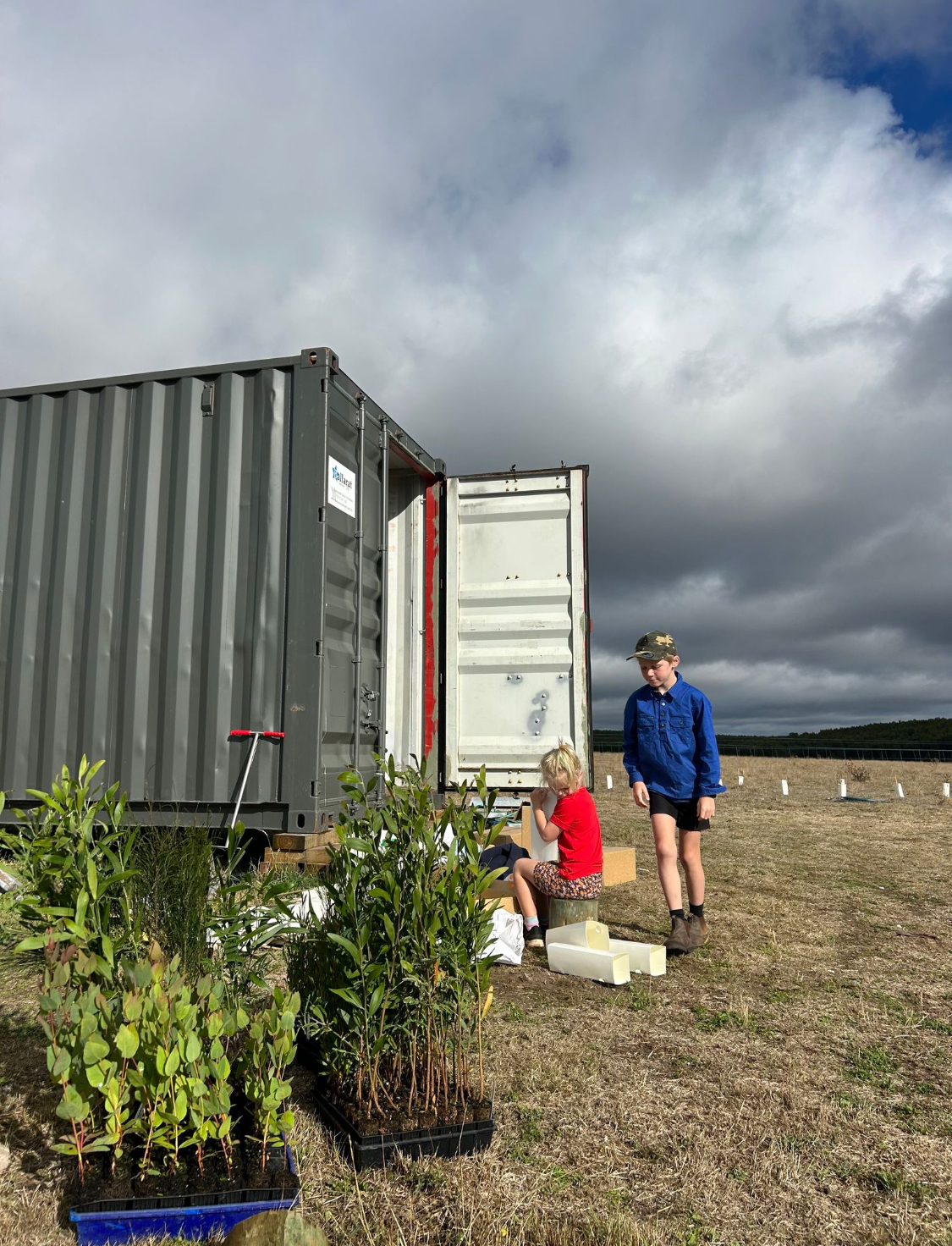

Grenville planting day.
These 90 new trees will provide habitat for local fauna, help prevent washing and erosion of the riverbanks during high flows, and increase the diversity of insect life, which in turn supports greater biodiversity in the river ecosystem. Native animals such as platypus, echidnas, parrots, magpies, kookaburras, cockatoos, eels and spiny freshwater crayfish will have new homes thanks to this revegetation work by the Hutchins family.
Thank you to everyone who contributed to Fifteen Trees, especially for supporting the trees planted at Grenville. The planting of these trees will be cherished by our family and the community today, and by future generations. Not only have we created new habitats and biodiversity, but by involving our children in the planting, we’ve taught them the importance of restoring trees and biodiversity in our landscape.
Emily and Jason Hutchens | Members | Grenville Landcare
Of course, this isn’t just about planting trees. It’s about creating homes, sanctuaries, and thriving ecosystems where our iconic native wildlife can flourish. A big thank you to Ballarat Go Karts for teaming up with us to make a real and lasting difference to our local environment.
If you would like to know more about sponsoring community tree planting projects and how we can assist you in becoming a more sustainable business, please contact Colleen at <[email protected]>.
Writer – Lou Ridsdale
Lou a green thumb, Earth Lover, big-hearted nature freak, plus a savvy media and horticulture expert, who passionately believe that everyone can lead a more nourishing and sustainable life. Lou founded Food Is Free Inc., a unique grassroots food security platform specialising in food security education. You can find Lou here.


